
Pay Rate Converter
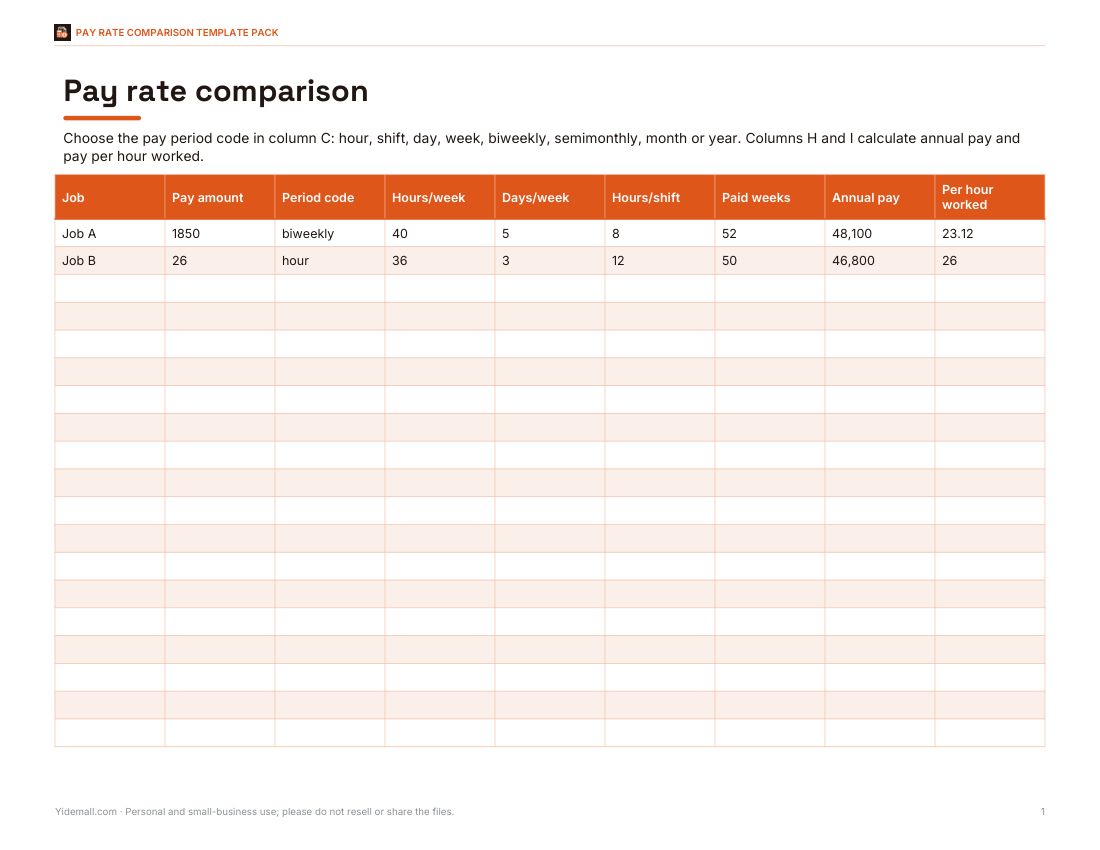
A job ad says $1,850 every two weeks, another says $26 an hour for 36 hours, and your current job pays per shift. This converter puts every pay rate on the same footing using your actual schedule, then compares two offers side by side.
- Free to use
- No sign-up
- Runs in your browser
Pay rate converter
Pay Rate Comparison Template Pack
Excel pay comparison workbook for multiple offers in any pay period, a printable job offer comparison sheet, a pay period reference card, an hours and pay tracker and a salary negotiation worksheet.
- Pay comparison (XLSX)
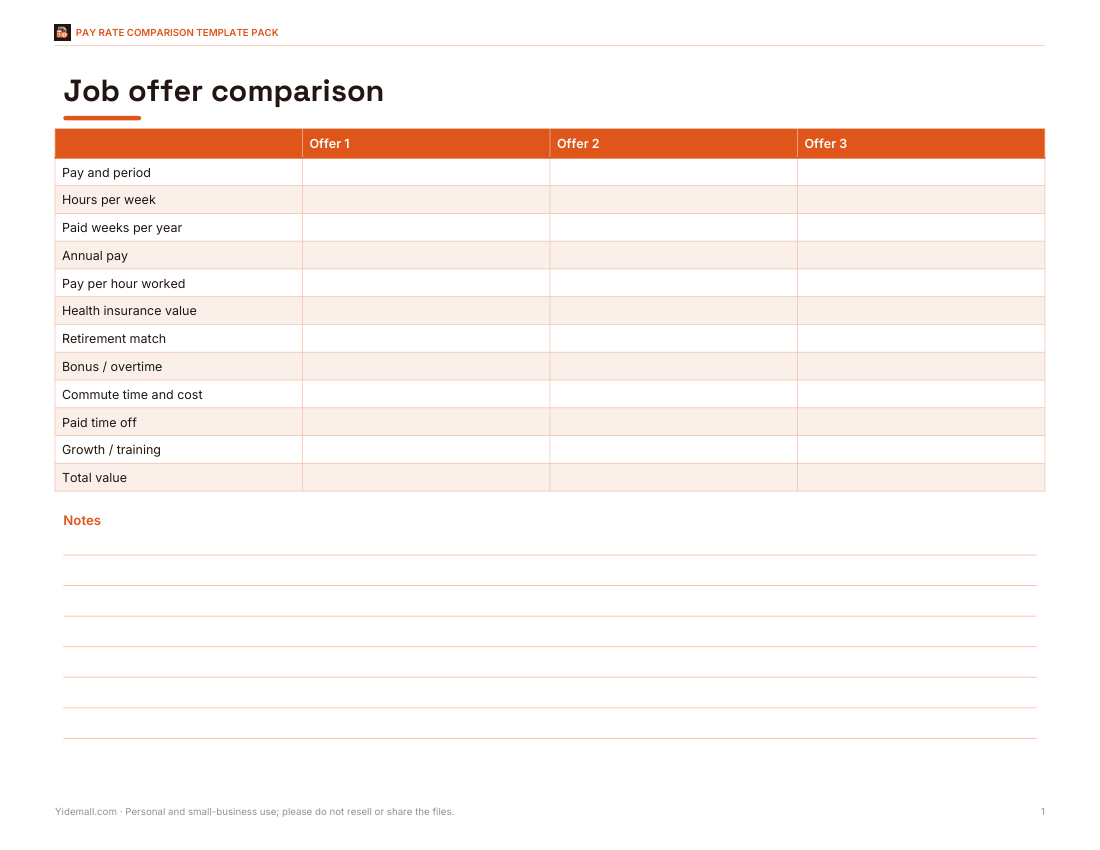
- Offer comparison (PDF/DOCX)
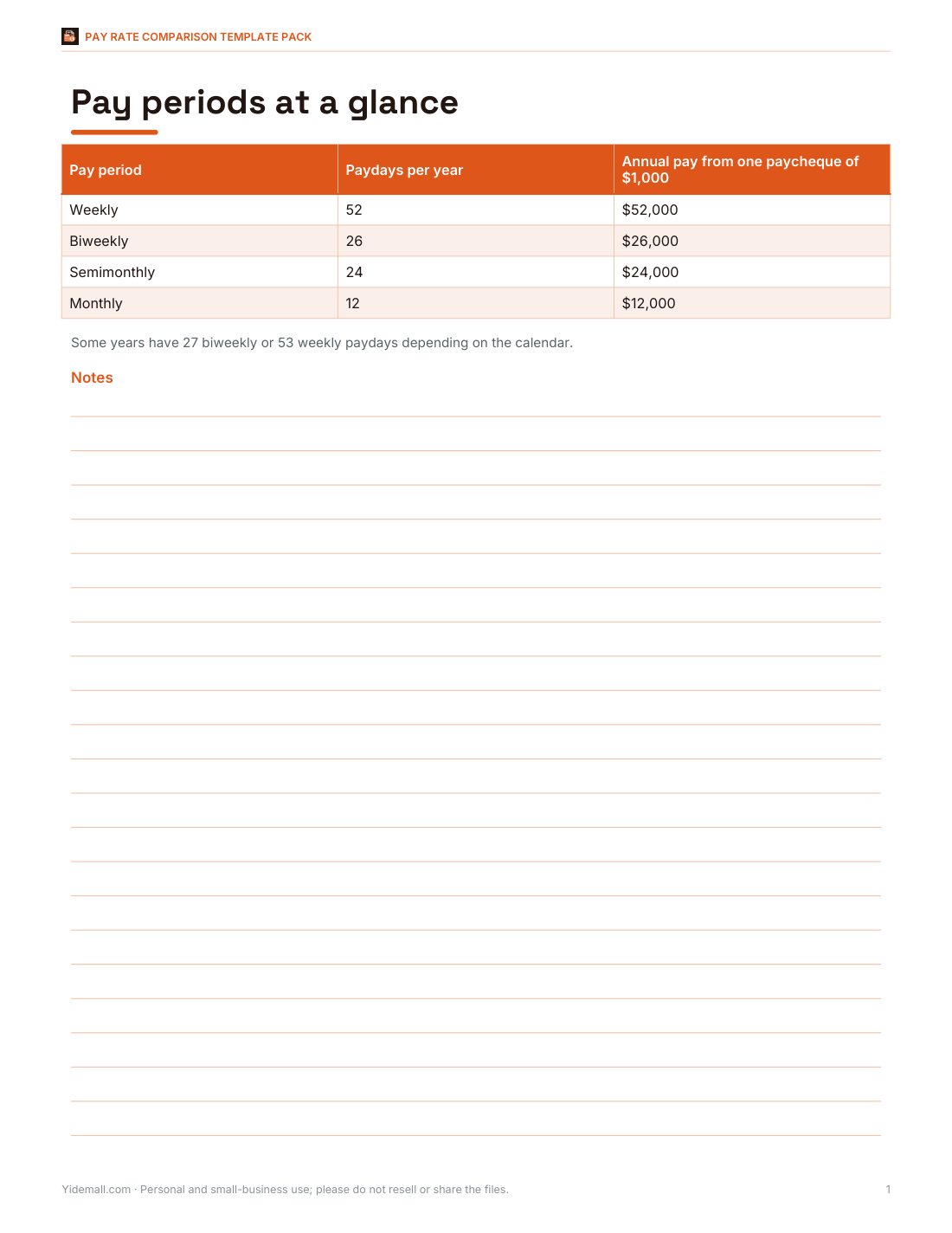
- Pay period reference (PDF/DOCX)
- Hours tracker (PDF/DOCX/XLSX)
- Negotiation worksheet (PDF/DOCX)
Formats: XLSX, PDF, DOCX. Instant download after payment (link valid 72 hours, up to 5 downloads). AI-assisted: the templates were drafted with AI help and reviewed and laid out before publishing.
$5.00 USD, one-time 5 files · about $1.00 each
- Instant download
- 7-day refund
- Secure checkout by Stripe
7-day money-back guarantee. Full refund within 7 days of purchase, even after you download.
Free sample: Pay Comparison Workbook (PDF, 55 KB)
Full refund within 7 days — see the refund policy and license.
Free printables
Single sheets you can print right now, no sign-up. The full pack adds every sheet in one download plus the editable files.
 Printable Pay Rate Comparison Sheet
 Printable Job Offer Comparison Sheet
 Printable Pay Period Reference Chart
 Printable Hours and Pay Tracker
 Salary Negotiation Preparation Worksheet
How pay periods relate
| Pay period | Paydays per year | To annual pay |
|---|---|---|
| Hourly | — | rate × hours per week × paid weeks |
| Per shift | — | rate × shifts per week × paid weeks |
| Daily | — | rate × days per week × paid weeks |
| Weekly | 52 | pay × 52 (or paid weeks) |
| Biweekly | 26 (occasionally 27) | pay × 26 |
| Semimonthly | 24 | pay × 24 |
| Monthly | 12 | pay × 12 |
| Annual | — | as stated |
Biweekly and semimonthly are easy to mix up. Biweekly means every other week — 26 paydays in most years. Semimonthly means twice a month, often on the 15th and last day — 24 paydays. A $2,000 biweekly paycheque is $52,000 a year; a $2,000 semimonthly paycheque is $48,000.
Worked example: comparing two offers
Job A pays $1,850 every two weeks for a standard 40-hour, 5-day week with 52 paid weeks: that is $48,100 a year, or $23.13 an hour. Job B pays $26 an hour for three 12-hour shifts (36 hours), with 50 paid weeks: $46,800 a year, or $312.00 per shift. Job B pays about $1,300 less a year, but more per hour worked — and gives four days off a week. The converter shows both views so you can decide what matters to you.
Paid weeks and time off
Salaried pay usually continues through paid holidays and vacation, so an annual salary already covers them. Hourly, shift and daily pay only add up for the weeks you are actually paid. If you get two weeks of unpaid leave, set paid weeks to 50; if your holidays and vacation are paid, keep 52. Seasonal and contract work often has far fewer paid weeks — enter what you realistically expect.
Common pay conversions
| Hourly rate | Weekly (40 h) | Biweekly | Semimonthly | Monthly | Yearly (52 weeks) |
|---|---|---|---|---|---|
| $15 | $600 | $1,200 | $1,300 | $2,600 | $31,200 |
| $20 | $800 | $1,600 | $1,733 | $3,467 | $41,600 |
| $25 | $1,000 | $2,000 | $2,167 | $4,333 | $52,000 |
| $30 | $1,200 | $2,400 | $2,600 | $5,200 | $62,400 |
| $40 | $1,600 | $3,200 | $3,467 | $6,933 | $83,200 |
| $50 | $2,000 | $4,000 | $4,333 | $8,667 | $104,000 |
A quick mental shortcut for a full-time 40-hour week: double the hourly rate and add three zeros for the approximate yearly pay — $25 an hour is roughly $50,000 (exactly $52,000 with 52 paid weeks). Halve an annual salary in thousands to get an approximate hourly rate.
Shift work and compressed schedules
Nurses, firefighters, security staff and many factory workers are paid for shifts rather than standard days. Three 12-hour shifts make a 36-hour week; four 10-hour shifts make 40. Converting per-shift pay needs the number of shifts per week, which the tool works out from hours per week and hours per shift. Rotating schedules, such as a “Pitman” 2-2-3 pattern, average out to a set number of hours per week over the cycle — use that average.
Day rates and freelance pay
Freelancers and contractors often quote a day rate. To compare a day rate with a salaried job fairly, remember that contractors usually pay for their own holidays, sick days, equipment, insurance and extra taxes, and are rarely booked every working day. A day rate that looks much higher than an employee’s equivalent may end up similar once you set paid weeks to the number of weeks you realistically bill.
What the converter doesn’t include
- Income tax, social security and other deductions — use a paycheque calculator for take-home pay.
- Overtime premiums — add overtime as a separate hourly amount.
- Benefits such as health insurance, retirement matching and bonuses, which can be worth thousands a year.
- Commuting time and costs, which change the real value of each hour.
- Shift differentials for nights or weekends.
Tips for comparing pay
- Convert everything to both yearly pay and pay per hour worked.
- Check whether salaried roles expect more than 40 hours — 50 hours a week lowers the real hourly rate by 20%.
- Ask how many paid holidays and vacation days come with each job.
- Put a value on benefits using the pack’s comparison worksheet.
- Remember that some pay rises are percentage-based, so a higher base compounds over time.
What’s in the template pack
- Excel pay comparison workbook: two or three offers, any pay period, benefits and commuting
- Printable job offer comparison sheet
- Pay period reference card (biweekly vs semimonthly, paydays per year)
- Hours and pay tracker for hourly and shift work
- Salary negotiation preparation worksheet
The converter is free; the pack is a one-time download for planning and records.
AI-assisted content
This page and the templates were drafted with AI assistance and reviewed before publishing. They give gross pay estimates, not tax or legal advice.
Frequently asked questions
How do I convert an hourly rate to a salary?
Multiply the rate by hours per week and paid weeks per year — $25 × 40 × 52 = $52,000.
What is the difference between biweekly and semimonthly?
Biweekly is every two weeks (26 paydays); semimonthly is twice a month (24 paydays).
How do I convert a salary to an hourly rate?
Divide the annual salary by hours per week × paid weeks per year.
How do I convert per-shift pay?
Shifts per week = hours per week ÷ hours per shift; multiply by the shift rate and paid weeks.
Does this show take-home pay?
No, these are gross figures before tax and deductions.
How many biweekly paydays are in a year?
Usually 26, but some years have 27 depending on where paydays fall.
How do I compare a day rate with a salary?
Multiply the day rate by days per week and the weeks you realistically work, then compare the annual totals.
What if my hours change each week?
Use your average hours per week over a typical month or pay cycle.
Is the template pack a subscription?
No, it’s a one-time download.